
“Look at that! That is a complete fucking fraud, and it looks a hundred percent real. It’s the best work I’ve ever done in my life, because it’s so honest.”
Stanley Motss (Dustin Hoffman)
Nowadays, I often find myself wondering what on earth happened to the mid-budget movie that we used to see in the 90’s. These films weren’t your indie darlings made on a shoestring budget, nor were they the big blockbusters with a budget over $70 million. No, these were films that featured the big stars, the De Niro’s and the Hoffman’s but also had the character actors like Margo Martindale and William Fichtner acting alongside them. (Also, what happened to the character actor is another question I find myself asking frequently). These mid budget films were often aimed at the more mature audience, I’m talking about the over 30’s here. There’s no drive to make these types of films any more because everything has moved to television and streaming, and we all know how that’s turning out, right?
There’s no drive to make mid-budget films for general release nowadays. As discussed in an article by Neil Lyer for “Independent Magazine”, one of the reasons is that there’s no guaranteed return for these films, they’re not the “economic powerhouses they used to be”. As Lyer describes it, “Mid-budget films don’t have the extravagance of larger-budget movies or the quirky minimalism of independents, but they allow filmmakers to expand their creative pallets.” However, directors such as Frank Darabont, Nicolas Winding Refn, Steven Soderbergh and David Fincher have retreated back to the ‘small screen’ to tell complex stories where they don’t have to face the restraints of mainstream blockbuster cinema that seems to be all the rage nowadays.
“The filmmakers are clearly not picking a political side. In fact, they’re pointing out the hypocrisy of the whole political system. Everyone who appears in the film has their own agenda.”
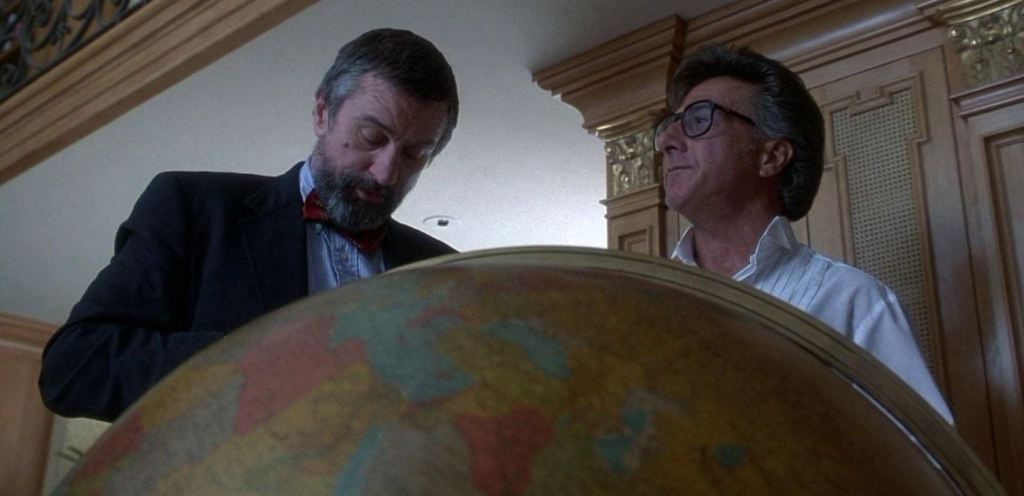
Nowadays, we don’t get the likes of Barry Levinson‘s “Wag the Dog” gracing the big screen. Instead we get “Don’t Look Up” by Adam McKay being available to stream on Netflix, a film they did try to push at the Oscars, but it failed to have the bite that Levinson’s “Wag the Dog” had upon its release and still haves to this day.
Watching “Wag the Dog” I was struck by how relevant it seems in our contemporary society. The media pushing a fake narrative of an impending war with Albania (no-one knows where it is so it’s a perfect country to pick) in which they essentially create a propaganda film full of special effects and professional actors. All of that is to simply cover up a White House scandal that involves a president getting a little too friendly with an underaged girl. People getting offed by the secret service because they know too much. Of course, “Wag the Dog” is satire. It’s just fiction with a dash pinch of reality thrown in. I’m not trying to imply anything about the current political climate at all, I’m just making an observation…
Where was I?
Oh yes.
“Wag the Dog” is a 1997 mid-budget film starring some rather big names, Robert De Niro, Dustin Hoffman and Anne Heche (who is now part of her own conspiracy). The countdown is on for the next election, with the current president campaigning for a second term with a dreadful campaign video, something along the lines of “you don’t change horses in midstream”. Things are going well, until the president gets a little too “hands on” with an underaged girl. Of course, despite your opinions about the current guy and the last guy, there has been a definite case of a president getting too ‘friendly’ with an intern. In a wonderful case of “you couldn’t make this up”, the film was released one month before the outbreak of the Clinton–Lewinsky scandal and the subsequent bombing of the Al-Shifa pharmaceutical factory in Sudan by the Clinton administration in August 1998.

“Nowadays, we don’t get the likes of Barry Levinson’s “Wag the Dog” gracing the big screen. Instead we get “Don’t Look Up” by Adam McKay.”
In order to distract the public’s attention away from the scandal, Conrad Brean (De Niro), a top spin doctor, is brought in by presidential aide Winifred Ames (Heche). Brean’s solution is to create an imaginary war with Albania. He brings on top Hollywood producer Stanley Motss (Hoffman) to create the war, complete with a theme song (created by none other than Willie Nelson) and fake film footage of a fleeing orphan (Kirsten Dunst) who is clutching a kitten (because who doesn’t love kittens and orphans?).
The fake war is initially successful, with the president quickly gaining ground in the polls. However, then the CIA gets involved, and they want to bring the other guy into the oval office and they’re not too happy with the whole fake war thing (basically, they don’t like being kept out of the loop). So, they decide to end the war and then the media’s attention instantly shifts back to the sex scandal.
Motss isn’t to be deterred by the likes of the CIA, and creates a wonderful story of a solider left behind enemy lines, an American hero who has been discarded like an ‘old shoe’. They even find a solider with the name Sgt. William Schumann (Woody Harrelson), who can play the new role. Now, Brean and Motss have the entire public behind them and the case. Of course, things don’t go exactly according to plan.

“Of course, “Wag the Dog” is satire. It’s just fiction with a
dashpinch of reality thrown in. I’m not trying to imply anything about the current political climate at all, I’m just making an observation…”
The film sizzles with brilliant dialogue, thanks to a killer script by David Mamet and Hilary Henkin, (the film is based on the book “American Hero” by Larry Beinhart). All of the key players deliver great performances, with Harrelson being an absolute delight as the mentally unhinged Sgt. Schumann. There’s so much to sink your teeth into and enjoy with “Wag the Dog”.
“Wag the Dog” is a film we unfortunately don’t seem to have nowadays. The filmmakers are clearly not picking a political side. In fact, they’re pointing out the hypocrisy of the whole political system. Everyone who appears in the film has their own agenda, and they’re all in for their own gains whether it’s a political gain or to gain commercial success. “Wag the Dog” also shows the uncomfortable relationship that politics has with Hollywood, something that a lot of people tend to ignore. The film also reflects the narcissism of the Hollywood creative with Motss’ own demise being the result of his ego, he can’t accept the fact that he will never get the credit for all of his “work”.

“Don’t Look Up” attempted to be this generation’s “Wag the Dog” but it didn’t really have the nuance or the sophistication that “Wag the Dog” has. The filmmakers treat the audience with a level of respect, and we’re not hit over the head by gag after gag. I find myself investing in the story, because it’s so outlandish and I personally I want Brean, Ames and Motss to pull it off. The film went on to be a hit, earning $64 million against a budget of $15 million, something that really wouldn’t occur in today’s climate.
Sadly, we might not get another “Wag the Dog” anytime soon, but because this is such a cleverly crafted and well-written film, we can return to it anytime. I suspect that this film will remain relevant, no matter who is in the oval office.


 The Film Bee Reviews
Leave a comment