“Animals are fine, but their acceptability is limited. A little child is even better, but not *nearly* as effective as the right kind of adult.“
Lord Summerisle (Christopher Lee)
I must admit that when I first saw “The Wicker Man” (1973) I wasn’t disturbed by it. I found the film to be amusing, with it’s silly costumes and naked people jumping about all over the place. I was left feeling disappointed because I wasn’t scared by the film’s conclusion. I felt cheated as in my naïve and misguided opinion as the majority of the film lacked any real significant moments of ‘horror’. I found the character of Sergeant Howie (Edward Woodward) to be boring and cold. It was hard to connect with Howie, and the impact of his demise was lost on me. I preferred horror films where the main character was portrayed in a more sympathetic fashion, and Howie was so stubborn with his beliefs in the film that it was hard to sympathise with him.
Upon re-watching “The Wicker Man” I can admit that I was wrong. It is perhaps one of the most disturbing horror films I’ve encountered and Howie’s fate is something we should sympathise with. Even if you don’t consider yourself to be religious, you can find the horror in the cult mentality that the people of Summerisle and how closed communities can corrupt the flesh and minds of all those involved. “The Wicker Man” is a cautionary tale of how cults can corrupt even innocent children, and what can happen when all sense of law, order and authority is stripped away from a society.
“The Wicker Man” centres on the visit of a police officer, Sergeant Neil Howie, to the isolated Scottish island of Summerisle in search of a missing girl, Rowan Morrison (Geraldine Cowper), after receiving an anonymous letter. Howie, a devout Christian, is appalled to find that the inhabitants of the island have abandoned Christianity and now practise a form of Celtic paganism, but he knows that he has a duty to investigate the case so he remains present on the island.

When he first arrives, the inhabitants of the Island, aren’t exactly forthcoming with any information regarding Rowan. In fact, they tell him that no such girl has ever existed on the Island and that May Morrison (Irene Sunter) (who runs the Island’s post office) only has one daughter.
“Even if you don’t consider yourself to be religious, you can find the horror in the cult mentality that the people of Summerisle and how closed communities can corrupt the flesh and minds of all those involved.”
Howie decides to pay May a visit, and she confirms what the men at the dock claimed. She only has one daughter. When May is distracted, Howie decides to question her daughter, who is drawing a picture of a hare (a symbolic animal in paganism), and tells him that Rowan has been changed into a hare. This is our first indication that the missing girl may have actually existed.
In fact, the signs of Rowan’s existence are all there hidden in plain sight, and the islanders mock Howie with their power and knowledge over him. Perhaps the best example of this is how Alder MacGregor, the landlord (Lindsay Kemp) of The Green Man Inn (where Howie is staying), stands next to the wall where the missing picture of the May Queens of the past years are hanging on the wall. It’s the landlord’s way of drawing attention to the most important clue that will prove Rowan’s existence, but Howie is too caught up in his feelings of disgust and superiority over the Islanders, that he’s blind. MacGregor says that the picture frame has been damaged, which seems like a valid excuse, if it wasn’t for the fact that one of the other picture frames is damaged.

Quickly it becomes apparent that all of the Islanders are in on the act of driving Howie to a state of madness. During his first night, Willow (Britt Ekland), the landlord’s daughter, tries to seduce the police officer, by dancing naked in her room next to his and singing to him. However, Howie refuses to give into his temptation, as he has taken a vow to remain a virgin until he is married. It’s worth noting that the majority of the women we encounter in the film are blonde, reinforcing the concept of the blonde as a seducer and someone not to be trusted. In case, you’re interested in the historical importance of the ‘Blonde seducer’ then you might want to read this New York Times article.
The next day, Howie continues his investigation and makes his way to the Island’s school where he butts head with the schoolteacher Miss Rose (Diane Cilento) who at first denies any knowledge of the missing girl but after Howie ‘discovers’ the school register, she directs him to the girl’s grave. As you may have noticed, I put air quotes around the word ‘discovers’ as Miss Rose makes no attempt to hide the register and immediately gives Howie the information he requires. As I mentioned before, all of the Islanders are in on the joke and seem to be deliberately trying to drive Howie mad.
“Certainly, on the surface, it seems that the people of Summerisle appear eccentric and just a bunch of fun-loving hippies who went a bit far.”
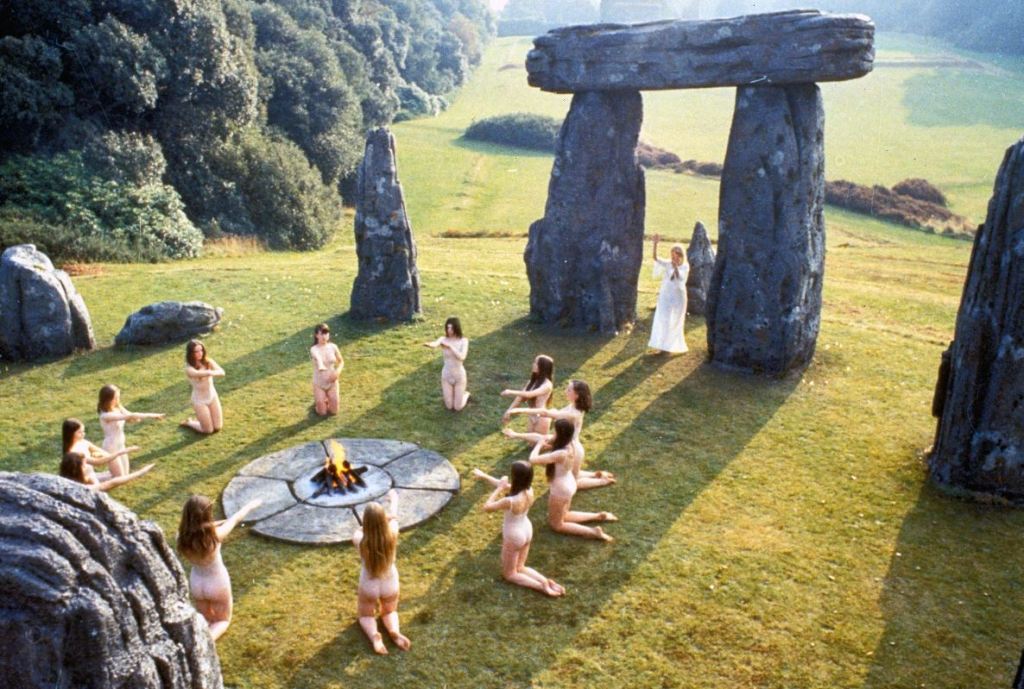
Howie finally meets the Island’s mysterious Lord Summerisle (played wonderfully by Christopher Lee), who provides Howie with a background to the Island’s strange practices and beliefs. Celtic paganism had resurfaced into the public consciousness during the 1950s and 60s, with the likes of Gerald Gardner and Cecil Williamson reviving the Pegan faith and practicing Wicca. Both men have some fascinating ties to the Freemasons and also the MI6 which is a whole strange rabbit hole that I fell down into. Interestingly, in the film, Lord Summerisle discusses how his grandfather was a Victorian agronomist, and this seems to be a nod to the aristocratic backgrounds of Gardner and Williamson.
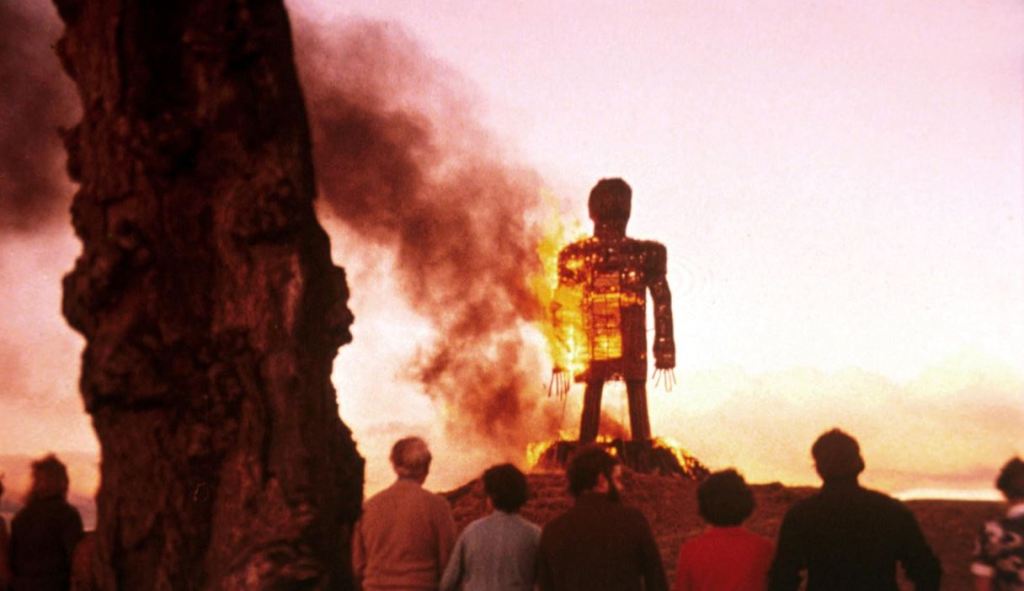
I must admit that until recently I wasn’t aware of the history surrounding the beliefs of the Celtic Pagans, and I must admit that the film’s screenwriter Anthony Shaffer and director Robin Hardy, did an excellent job in depicting the practices of the ancient Celts. The burning of a Wicker Man, was an act that did indeed take place, and according to Julius Caesar in his Commentaries on the Gallic War: “Others have figures of vast size, the limbs of which formed of osiers they fill with living men, which being set on fire, the men perish enveloped in the flames.”
And, it was the image of the wicker man, which gave the filmmakers their title. For Shaffer, this was “the most alarming and imposing image that I had ever seen.” I agree with Shaffer, that the image of Howie being burnt alive in the Wicker Man is certainly alarming, and despite his standoffish attitude, he certainly doesn’t deserve his fate.
“We may be led to believe that the people of Summerisle are all complicit and happy to partake in the killing of Howie, but to me they look like zombies as they sing and hold hands. In my opinion, they’ve essentially been stripped of their free-will.”
I’ve read articles and reviews where critics have downplayed the actions and attitudes of Lord Summerisle, and the Islanders, and have tried to paint the idea that Howie kind of deserves his fate for his bigotry towards the Pagans. Certainly, on the surface, it seems that the people of Summerisle appear eccentric and just a bunch of fun-loving hippies who went a bit far. You may even believe the film is Pro-paganist, but as discussed by JP Nunez for Horror Obsessive, “The Wicker Man isn’t pro-Paganism. These people are cold-blooded murderers, and they do it with smiles on their faces. They’re clearly evil.” Despite all of this, viewers still seem to be reluctant to side with Howie and don’t regard him as a victim.

Nunez’s piece is very interesting, as he points out that the film isn’t as simple as being pro or anti Christianity. He writes, “The movie isn’t telling us that Christianity is bad. Rather, by criticizing the sergeant for not following the teachings of his faith, the film is subtly telling us that those teachings are in fact good. The problem is simply that we Christians often don’t practice what we preach.” Instead of being humble about his beliefs, Howie had been arrogant and it was his desire to be proven ‘right’ about the people of Summerisle being depraved maniacs, which led him to be killed.
As I mentioned previously, I think what makes “The Wicker Man” so disturbing is the way that the filmmakers depict the dangers of cult mentality and the horror of belonging to an isolated community. We may be led to believe that the people of Summerisle are all complicit and happy to partake in the killing of Howie, but to me they look like zombies as they sing and hold hands. In my opinion, they’ve essentially been stripped of their free-will.
Essentially, they belong to a cult run by Lord Summerisle. Their happiness comes from a good performance, and that’s what they are doing at the end of the film, they’re performing for their Lord. There’s also a chilling thought, that he will only remain their ‘God’ if the harvest returns, and the mob may turn on him and he will become the sacrifice. This is something that I think many viewers overlook, the idea that being a seen as ‘Godlike’ is a fleeting thing and ultimately there will be no victors.
Photos courtesy of IMDb.


 The Film Bee Reviews
Leave a comment