
This is just like television, only you can see much further.
Chance (Peter Sellers)
Based on the satirical novel by Jerzy Kosinski, “Being There” (directed by the ever wonderful Hal Ashby) is a black comedy. The Film examines how we construct false narratives, based on how we wish to perceive information from our own social/economic class. Peter Sellers gives his career-best performance as Chance the Gardener, who gets mistaken as a wealthy ex-business man. And through an extraordinary set of miscommunications, ends up becoming the most influential person in America.
Our sense of perception on how the world operates, is based on how we interpret objects and people. And how we associate meaning to certain events and try to process them. We come across the strange and unusual everyday, and some how we need to make sense of it. “Being There” is simply reminding us of how fragile our state of being actually is.
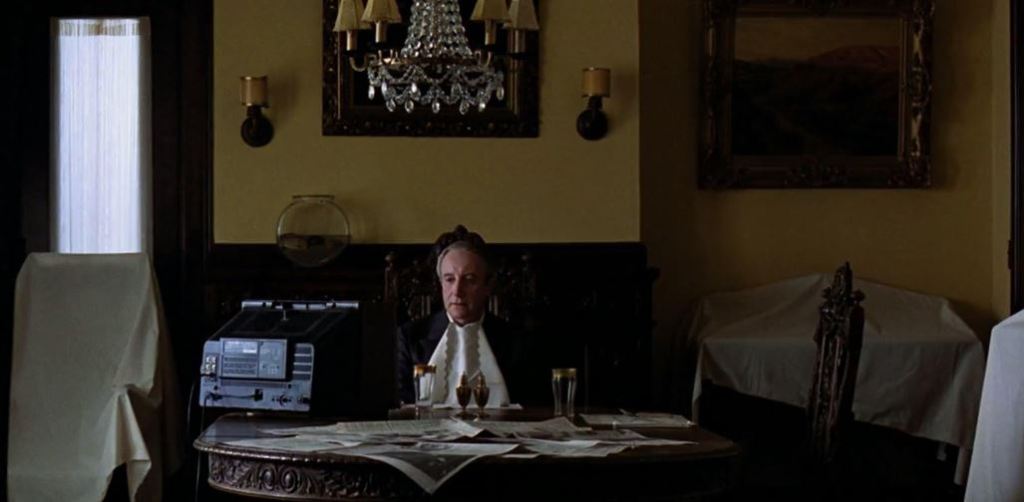
When we first meet Chance, we see that from the very second he wakes up he watches television. Chance is a simple man, who has lived the entirety of his life inside the house and grounds of a wealthy gentleman, referred to only as ‘the old man ‘. His only past-times seem to be gardening and watching television, which is his only access to the world beyond his walled garden. His own twisted version of the garden of Eden.
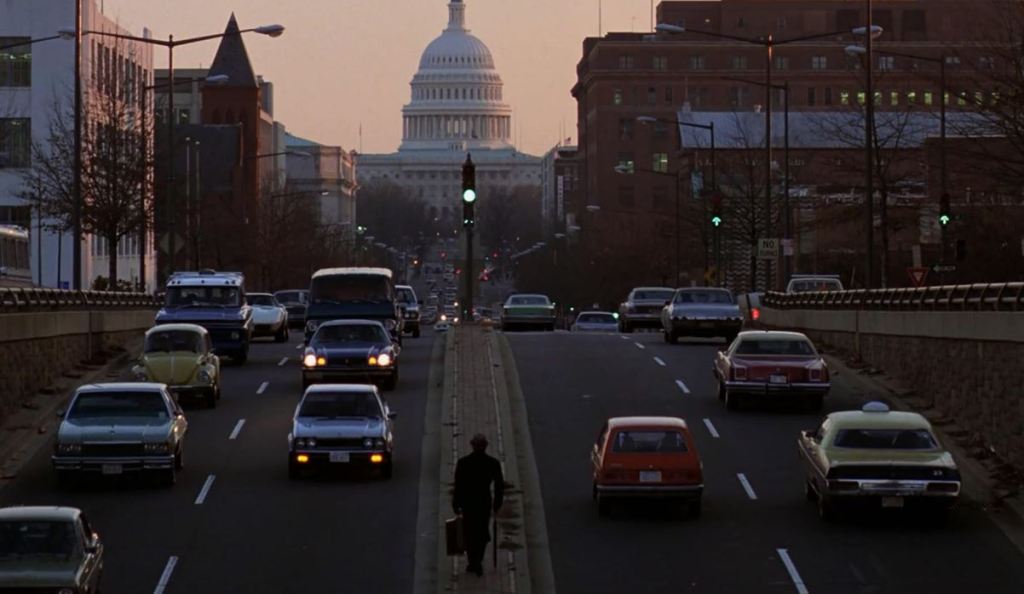
When the old man suddenly dies, Chance is forced to leave the house for the first time in his life. As Chance steps outside, a disco rendition of Also Sprach Zarathustra (the piece of music from the start of 2001: A Space Odyssey) begins to play. Essentially this is Chance’s mission into the universe and we will go on this ‘out-of-space’ odyssey with him.
“Being There” is simply reminding us of how fragile our state of being actually is”.
He wanders the streets alone, encountering a gang of local youths along the way. Chance responds to having a knife pulled out on him by using his remote control as if trying to change over the channel. Distracted by a shop window, he is hit by a limousine carrying Eve Rand (Shirley MacLaine). Eve is the wife of a prominent, politically influential financier, Benjamin Rand (Melvyn Douglas).
Eve believes that Chance is a member of the wealthy upper class, and to avoid legal troubles over the collision, she invites him home to treat his minor injuries. This is the first case of miscommunication, as Eve mishears Chance’s name as Chauncey Gardiner. The thing is, that Chance doesn’t correct her and simply goes along with this change of name. It helps that his clothing and appearance reinforces Eve’s narrative, that he is part of the same social class.
Chance models his behavior from what he’s seen on television. Even mimicking the same style handshake he’s seen the President do. Knowing certain handshakes certainly goes a long way. When he arrives at the Rand household, his presumed identity overshadows anything he says or does. The people around him interpret his words to suit their understanding and maybe use it to their own advantage.
“Chance is a man of few words, he seems to know just what to say to connect with his audience.”
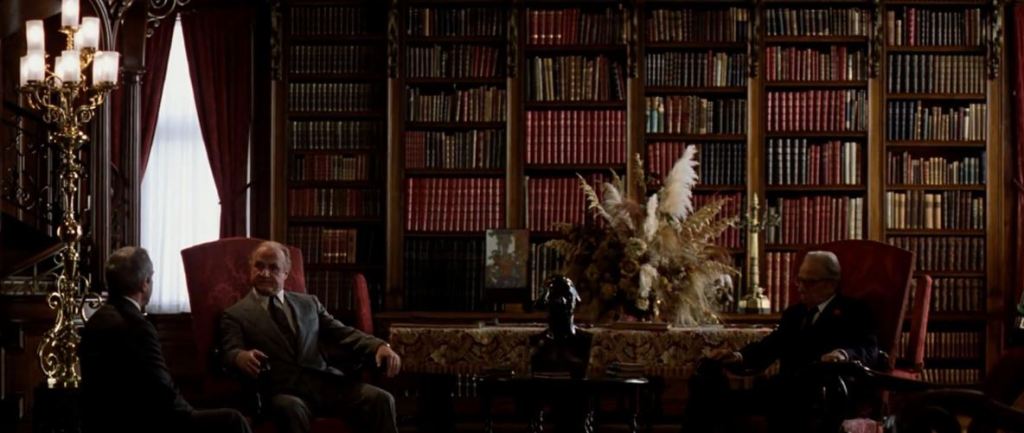
Chance makes a positive impression on Benjamin Rand, as well as the visiting President (Jack Warden). Chance’s behavior puts people at ease, which allows them to relax around him. He often repeats his companion’s statements during a conversation which creates the impression of agreement. He maintains eye contact with his companion, again reinforcing this idea of empathy and creating a sense of ease. He often remarks, “I understand,” and “I know what you’re saying” in a calm tone, which other people interpret as Chance having a strong sense of confidence.
His brief and simplistic answers are interpreted as having a deeper and more philosophical meaning to them, and maybe he is simply commenting on gardening. Either way, Chance is a man of few words, he seems to know just what to say to connect with his audience. In 2025, one can easily make the parallel with Donald Trump, who goes out of his way to use the simplest terminology to get his point across.
Even when he confesses that he can’t read, people interpret this as being a comment on the busy, hectic lifestyle that enslaves us all, denying us the simple pleasures of reading. His confession being unable to read newspapers and only watching TV is conveyed as being his mistrust of print journalism. Honestly, Chance has a point here.
After a meeting with the President, who ends up quoting him on live TV, Chance ends up becoming a well-known figure. Both the press and the secret service takes an interest in finding out his true identity, but there appears to be nothing on him. He’s the perfect blank slate for anyone to use and adapt for their own intentions.
Faith in the President begins to waver. Especially when people interpret Chance’s comments as being an attack on the president’s ability to do the job that’s required. A perfect portrayal of how fickle the world of politics can be. Remember, how an aide whispered to someone that British PM Margaret Thatcher, looked “tired” and that led to a leadership challenge within her own party? Eventually in 1990, she left 10 Downing Street in tears.
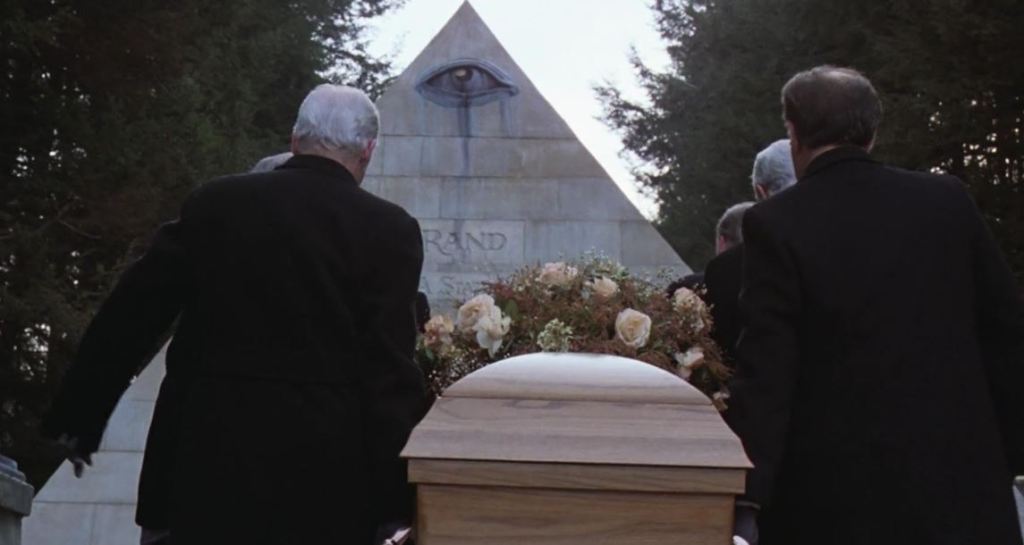
The film ends with a bunch of elitist men from the Old Word Order bickering between them to decide who will become the next leader of the “free world”. A chilling reminder that true power is only in the hands of a very exclusive and elite minority. And, let me just slip on my ‘tin foil’ hat for a second, but is that a pyramid with the ‘all seeing eye’ in front of them? Even if, you don’t buy into the whole ‘Illuminati’ secret society conspiracy theory, the ‘Eye of Providence’ is the symbol found on the Great Seal of the United States and the one-dollar bill.
Of course, the film’s most iconic shot of Chance walking on water, is the film’s actual ending. Like everything that surrounds Chance, this is open to interpretation. Is Chance the second coming? Has he managed to unburden his mind of all trivia to obtain true peace and consciousness?
The film’s last words are “Life is a state of mind.” But what does this statement mean exactly? It’s such a vague sentence, that we can view it in a range of different ways to suit our own narrative. This is what makes “Being There” such an outstanding film, because the viewer is allowed to come to their own conclusions and treated with an element of respect that is rarely seen today.
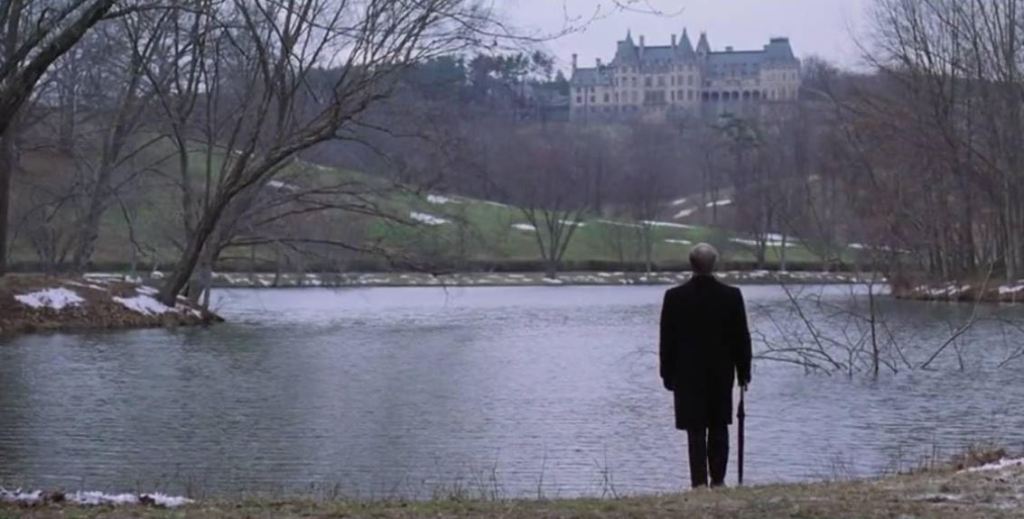
At the end of the day, we are left questioning whether we are actually being there in the moment, or whether our minds are too preoccupied with the screen. It’s time we all ventured outside the walls of our garden, and venture on our own odysseys. It’s time we stop being just there and start being.
Originally posted to Filmotomy: https://filmotomy.com/rewind-1979-in-film-being-there/

 The Film Bee Reviews
Leave a comment